Drafting commercial agreements involves more than turning an understanding between two parties into a written document. A well-drafted agreement defines what the parties have agreed to, what each party must do, when those obligations must be performed, and what happens if there is a delay, breach, or decision to end the commercial relationship.
The clearer the agreement and the more closely it reflects the transaction, the easier it becomes for a company to manage the relationship and reduce the risk of disputes. Effective commercial contract drafting therefore begins with understanding the transaction itself before selecting the legal provisions that should govern it, whether the agreement concerns supply, services, distribution, partnerships , or another commercial arrangement.
drafting commercial agreements: Summary of key points
| Topic | Key point |
|---|---|
| What Does Drafting Commercial Agreements Mean? | Drafting commercial agreements is the process of organising the legal and commercial relationship between two or more parties in a document that defines their rights, obligations, and the terms governing their dealings. |
| Key takeaways | Drafting commercial agreements is the process of organising the legal and commercial relationship between two or more parties in a document that defines their rights, obligations, and the terms governing their dealings. |
| Organising Obligations and Performance in Commercial Agreements | One of the main purposes of drafting commercial agreements is to turn general understandings into obligations that can be measured and monitored. |
| Managing Risk and Liability in Commercial Agreements | Drafting commercial agreements is not limited to describing what should happen when the business relationship proceeds as planned. |
| Terminating Agreements and Resolving Disputes | Even commercial relationships that begin positively need clear rules for bringing the agreement to an end. |
| Reviewing Commercial Agreements Before Signing | Reviewing an agreement before signature is essential for confirming that the final text accurately reflects what was agreed during negotiations. |
What Does this topic Mean?
this topic is the process of organising the legal and commercial relationship between two or more parties in a document that defines their rights, obligations, and the terms governing their dealings. It is not simply about using legal terminology. The purpose is to translate a commercial understanding into clear obligations that the parties can understand and perform.
The agreement should reflect the nature and actual risks of the transaction. A contract governing the supply of products will require different provisions from a services agreement, while a distribution agreement may involve issues that do not arise in a long-term commercial cooperation agreement.
Why Is Clear Commercial Contract Drafting Important?
Clear commercial contract drafting reduces the scope for disagreement over what the parties intended. When responsibilities, amounts, deadlines, and performance requirements are defined precisely, each party has a clear reference point throughout the commercial relationship.
Proper drafting can also help address risks before they become disputes. A commercial agreement should therefore be treated as a practical framework for managing the relationship rather than simply a document that must be signed before work begins.
Types of Commercial Agreements Companies May Need
Key takeaways
- this topic is the process of organising the legal and commercial relationship between two or more parties in a document that defines their rights, obligations, and the terms governing their dealings.
- The type of agreements a company requires depend on its business activities and how it deals with customers, suppliers, partners, distributors, and service providers.
- One of the main purposes of this topic is to turn general understandings into obligations that can be measured and monitored.
- this topic is not limited to describing what should happen when the business relationship proceeds as planned.
- Even commercial relationships that begin positively need clear rules for bringing the agreement to an end.
The type of agreements a company requires depend on its business activities and how it deals with customers, suppliers, partners, distributors, and service providers. These may include sale and supply agreements, service agreements, distribution agreements, commercial agency agreements, cooperation agreements, construction contracts, and confidentiality agreements.
The existence of a standard template does not mean that the same document should be used for every transaction. Risks and obligations differ between commercial relationships, so this topic should take account of the specific transaction and the parties involved.
Essential Information in a Commercial Agreement
A commercial agreement should clearly identify the parties, including their legal names, capacities, and relevant details. It should also define the subject matter of the agreement, its duration, effective date, consideration, key obligations, and any schedules or documents that form part of the contract.
Companies should also confirm that the person signing the agreement has the appropriate authority to bind the relevant party, particularly where one or both parties are legal entities.
Organising Obligations and Performance in Commercial Agreements
One of the main purposes of this topic is to turn general understandings into obligations that can be measured and monitored. Expressions such as "delivery within a reasonable time" or "providing services to the required standard" may appear understandable during negotiations but can lead to different interpretations once performance begins.
The agreement should therefore explain what each party will provide, when it must be provided, how performance will be assessed, what payment is due, and what happens if either party fails to perform as agreed.
Defining Each Party’s Obligations
Each party’s responsibilities should be described in a way that minimises uncertainty. In a services agreement, for example, the contract should identify the scope of services, expected deliverables, deadlines, and the respective responsibilities of the customer and service provider.
For supply agreements, the contract may need to specify quantities, technical requirements, delivery locations, delivery dates, and procedures for accepting or rejecting products. The more measurable the obligations are, the easier it becomes to determine whether they have been properly performed.
Payment, Delivery, and Performance Schedules
The agreement should specify the amount payable, currency, payment dates, and payment method, as well as whether payments will be made in advance, in instalments, or upon reaching defined milestones. The consequences of late payment should also be addressed where appropriate and legally permissible.
Where goods are delivered or services are performed in stages, the agreement should establish a clear schedule and identify each party’s responsibilities at every stage. It should also explain the procedure to follow if delays occur or the delivered work does not meet the agreed requirements.
Managing Risk and Liability in Commercial Agreements
this topic is not limited to describing what should happen when the business relationship proceeds as planned. The agreement should also address situations where problems arise, such as defective products, delays, disclosure of confidential information, or losses caused by a party’s failure to perform its obligations.
The allocation of these risks will depend on the transaction, its value, and each party’s ability to control or manage the relevant risk. Liability provisions should therefore be tailored to the commercial relationship rather than inserted without considering their practical effect.
Warranties, Liability, and Indemnity Clauses
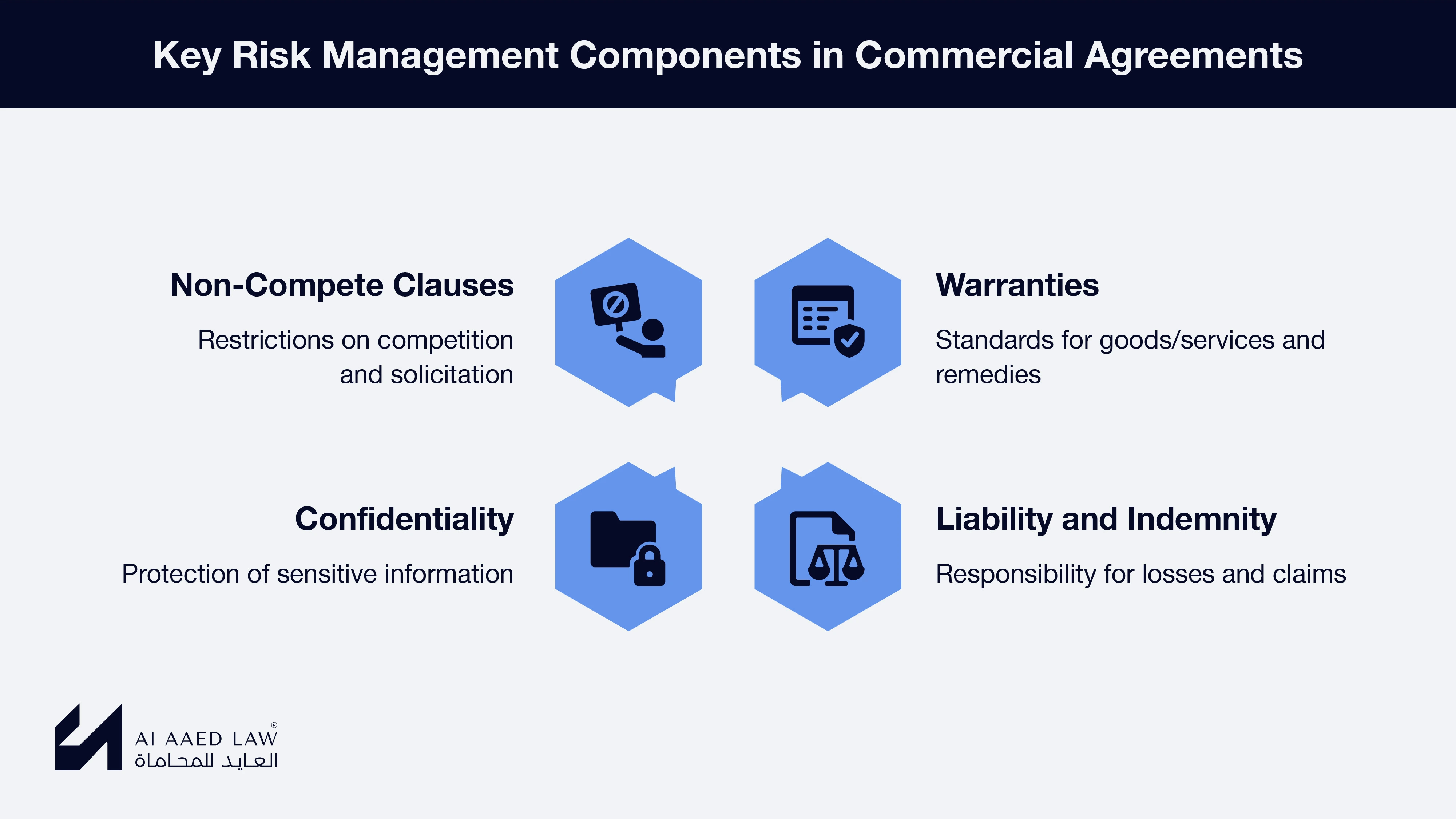
Warranty provisions establish the standards that goods or services must meet, how long particular warranties apply, and what remedies may be available if those standards are not satisfied.
Liability and indemnity clauses address circumstances in which one party may be responsible for losses, claims, or liabilities arising from its conduct or breach of contract. These provisions should be drafted carefully so that their scope is clear, proportionate to the transaction, and consistent with applicable law.
Confidentiality and Non-Compete Clauses
A commercial relationship may require parties to exchange sensitive information, such as pricing, customer data, business plans, technical information, or trade secrets. In these circumstances, the agreement should define what information is confidential, how it may be used, who may access it, and how long confidentiality obligations will continue.
Certain agreements may also contain restrictions relating to competition or the solicitation of customers or employees. These provisions require careful drafting regarding their duration, scope, and purpose, as well as consideration of their enforceability under applicable law.
Terminating Agreements and Resolving Disputes
Even commercial relationships that begin positively need clear rules for bringing the agreement to an end. A contract may expire at the end of its term, be terminated by mutual agreement, end because of a material breach, or be terminated in other circumstances specified by the parties.
The agreement should also establish how disputes will be handled if the parties cannot resolve them through negotiation. Addressing these issues when this topic can prevent additional uncertainty when the relationship is already under pressure.
Contract Termination Provisions
The agreement should identify the circumstances in which either party may terminate it, whether the defaulting party will have an opportunity to remedy a breach, how notices must be delivered, and what notice periods apply.
It should also address the consequences of termination, including payment of outstanding amounts, return of property or documents, handover of completed work, and the survival of obligations such as confidentiality after the commercial relationship ends.
Dispute Resolution, Jurisdiction, and Arbitration
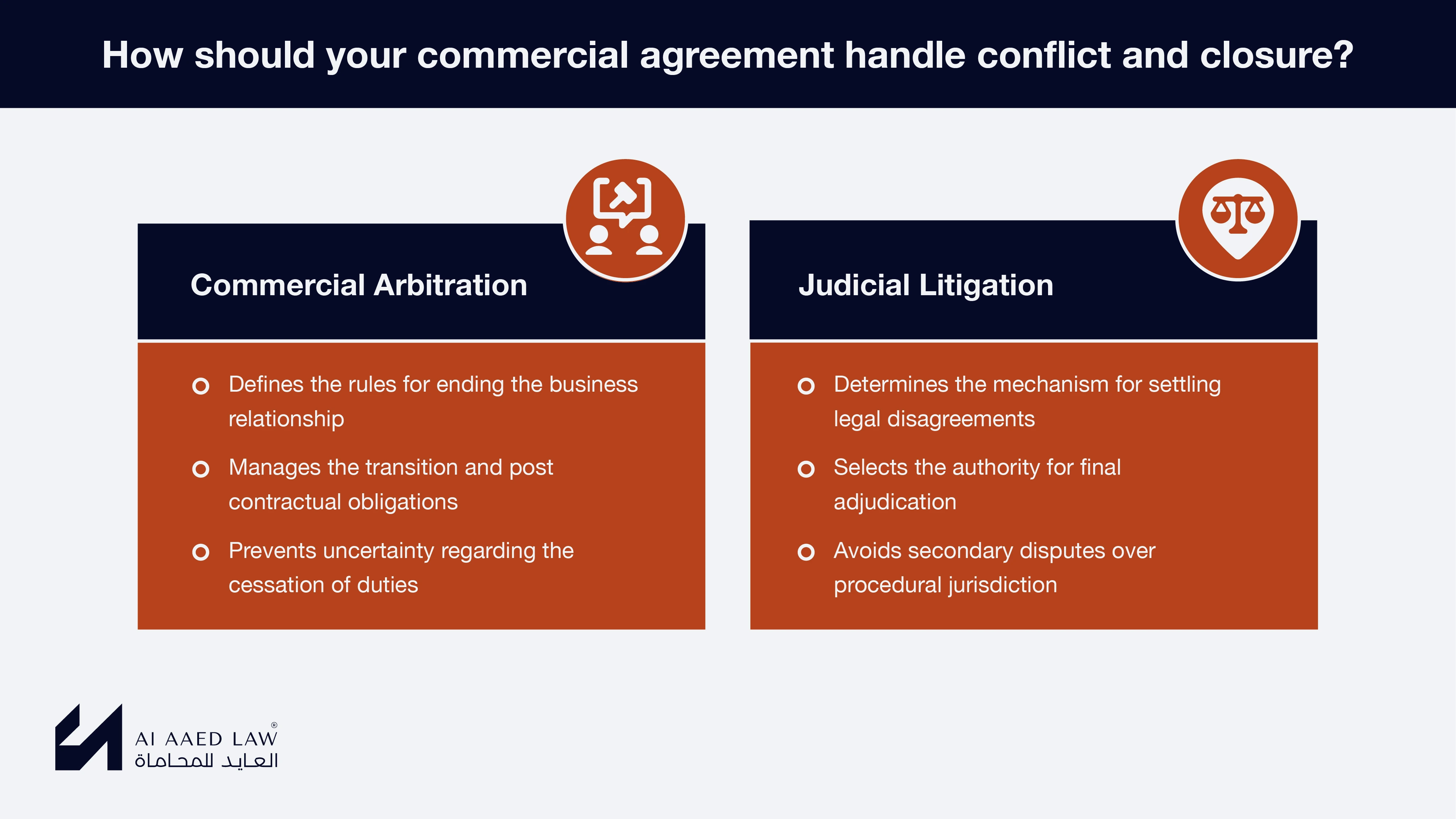
A commercial agreement should identify the governing law and establish how disputes will be resolved. Depending on the nature of the relationship, the parties may agree to submit disputes to the competent courts or use arbitration.
Where arbitration is selected, the relevant provisions should be drafted clearly and should address the essential elements appropriate to the agreement. An unclear dispute resolution clause can create an additional dispute over how the original dispute should be resolved.
Reviewing Commercial Agreements Before Signing
Reviewing an agreement before signature is essential for confirming that the final text accurately reflects what was agreed during negotiations. Commercial agreements may pass through several drafts, and amendments can sometimes create inconsistencies between clauses or leave outdated provisions in the final document.
A proper review should go beyond checking language and formatting. The parties should examine obligations, deadlines, payment terms, authority, termination rights, liability provisions, dispute resolution clauses, and any schedules or documents incorporated into the agreement.
Standard Templates vs Custom-Drafted Commercial Agreements
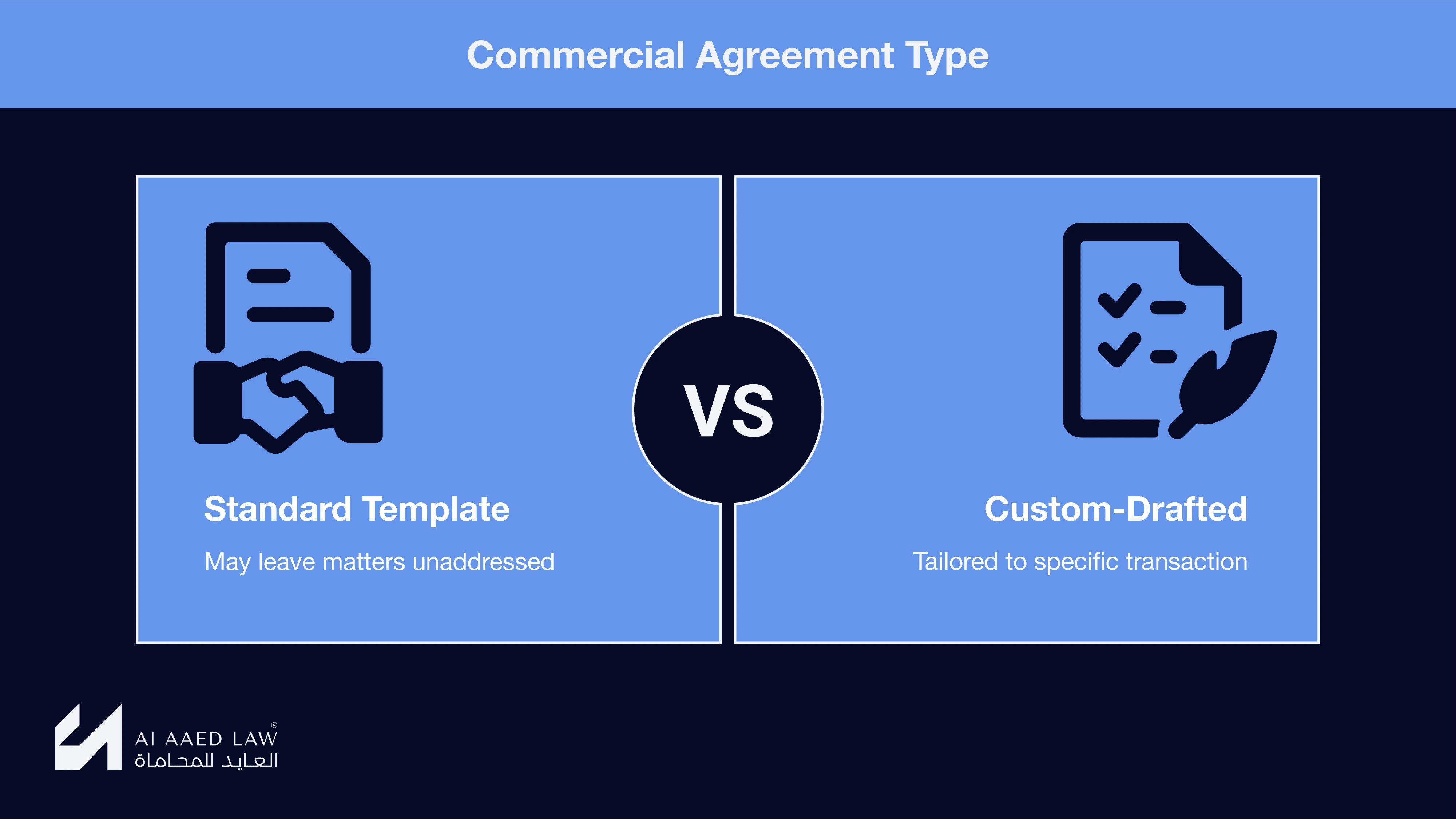
A standard contract template can provide a starting point in some circumstances, but it does not account for the specific transaction, the company’s operating model, or how risk has been allocated between the parties. Using a template without adapting it may leave important matters unaddressed or include provisions that are inappropriate for the transaction.
A custom-drafted agreement is based on the actual commercial relationship. The process begins by understanding the transaction, objectives, and risks before developing provisions that address those matters rather than assuming that all commercial arrangements require the same terms.
Common Mistakes When this topic
Common mistakes include using ambiguous language, copying provisions from unrelated transactions, failing to define deadlines, overlooking procedures for dealing with delays, and failing to establish clear termination or dispute resolution mechanisms.
Other issues include inconsistencies between the main agreement and its schedules, using different definitions for the same concept, granting overly broad authority without appropriate limitations, or signing before confirming that the final version includes all negotiated amendments.
When Does a Company Need a Commercial Contracts Lawyer?
Legal support becomes particularly important when this topic involving significant financial value, long-term obligations, substantial operational or financial risks, or parties located in different jurisdictions.
Legal review can help a company understand the obligations it is accepting before signature rather than addressing those obligations only after a dispute occurs. It can also help ensure that key provisions work together and are appropriate for both the transaction and the applicable legal framework.
Practical Tips Before Signing a Commercial Agreement
Before signing, the final version should be read in full and checked against what the parties actually agreed. This includes verifying the parties’ names, the authority of the signatories, amounts, deadlines, scope of work, payment terms, warranties, liability provisions, and termination mechanisms.
All schedules, annexes, and documents referred to in the agreement should also be reviewed. Important promises or understandings should not be left outside the final documentation, and provisions that are unclear or open to multiple interpretations should be addressed before signature.
This article is provided for general information only and does not constitute legal advice. For advice on a specific matter, contact AL AAED Law Firm.
Official source: Syrian Ministry of Justice